Saturday, 16 June 2012

Kostas Balafas


In 1920 Greek Photographer, Kostas Balafas was born into a poor dairy farming family in the mountain village of Kipseli in Arta. He started taking photographs when he was a student. Story has it he  sold his watch to supplement his small savings and pay for his first camera. Since film was scarce and expensive at this time, it is reported that Balafas used film that quite literally 'fell from the sky' from an Italian bomber during the German occupation to record the Greek army's advances on the Albanian front. 


He took part in the resistance and captured the conflict and it's effect on the people of the isolated villages in Epirus against the occupying fascists. His images have become valuable historical documents recording not only the marches and battles that took place, but also the destruction it had on the  families and communities of the area.


After the war, Balafas continued to record the simple daily life of the Greek people who were trying to live off the land, lakes and sea. He also spent time with some of Greece's most isolated monastic communities on picturesque mountainous peaks where women were not allowed and men felt closer to God. 


Many of these pictures of ordinary people were to become enduring images of a time long since gone and a dignified working class that had been through many wars and conflict to fight for the land that they were born to. During the 1960s Balafas photographed the changing face of progress, recording the building projects of huge dams and reservoirs which were constructed to quench the thirst of Greece's growing post War population.


In 1991 Balafas edited and published a book of his photographs. All of the material had been hidden under the wooden floor boards of a house in Ioannia for 31 years. He died in October 2011 aged 91. Later in life Balafas made many films and was one of the first cameramen of Greek television during a testing broadcast from Thessaloniki's International Exhibition. His contribution to  photography has made him one of the leading exponents of humanist photography in Greece. 


Fashion Shoot: Thieving Magpies


This was a fashion shoot I styled in 2008 for Self-Made Magazine. I worked with a great team. The pictures were taken by Swedish photographer Samir Hadg with the  actors Aoife Coughlan and Mark Gordon modelling. The jewellery was by three very talented  Irish designers Clare Greenan and Laura Caffrey of http://irishdesignshop.com and Yvonne Ryan (http://www.eveella.com/)
 A selection of pieces from Eve Ella

 The shoot was inspired by the real life story of the infamous duo Bonnie and Clyde. It was photographed on an August evening in the Dublin mountains as the sun was setting. We borrowed a beautiful blue vintage mini and used it as the get away car. It proved to be a great prop to display the pieces in. We had a lot of fun and frolics arranging the necklaces and bracelets inside and outside the car.

 Both pieces by Clare Grennan

The models were all dressed in black with stockings on their head, for their disguise but also to place more emphasis on the accessories.

As the sun set over Dublin bay we continued shooting into the night. Then we pictured the 'thieving magpies' making an escape over a rusty gate (above). I slung some of the necklaces on Aoife's shoulders like she was carrying them, rather than wearing them.

As darkness and rain began to fall we began making use of the car's headlights to create a more dramatic atmosphere. I love fashion shoots that contain narratives; they're always more gripping. In the stories the clothes and accessories become props, like in real life; it's all about fitting fashion into your world and breathing your life into it.

The very lovely Aoife Coughlan modeling her bounty!
Jewels by Eve Ella 

We had so much fun that evening. It just shows when you're working with the right people that share your creativity, magic can happen!

Photographs by Samir Hadg
Styling by Alva 

Monday, 16 April 2012

Stevie Nicks: Style Icon

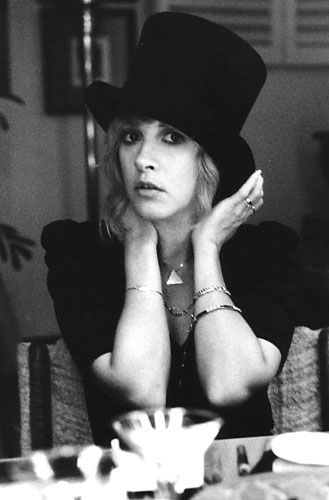
Born in Phoenix, Arizona in 1948, singer-songwriter Stevie Nicks is best known for her collaborative work in the 1970s and 80s with rock group Fleetwood Mac. She has also enjoyed a hugely successful solo career. Not only is she a poetic troubadour, but her creativity has undoubtedly influenced her bohemian sense of style. 

Perhaps it's her petite frame that initially encouraged her to make a big impression on stage with full flowing dresses, platform boots and top hats. Since she started appearing with the band in the 1970s she firmly took her place amongst some of the 20th Century's most legendary female style icons. Her feminine and artistic sense of dress has been in and out of fashion for the last 40 years; it has an ethereal quality and reflects her art with perfect symmetry. Here are the lyrics to one of her most beautiful songs from Fleetwood Mac's 1977 album Rumours; it was the band's first and only US No.1 and remained in the charts for 31 weeks. 


Dreams

Now here you go again
You say you want your freedom
Well who am I to keep you down
It's only right that you should
Play the way you feel it
But listen carefully to the sound
Of your loneliness
Like a heartbeat.. drives you mad
In the stillness of remembering what you had
And what you lost...
And what you had...
And what you lost


Thunder only happens when it's raining
Players only love you when they're playing
Say... Women... they will come and they will go
When the rain washes you clean... you'll know
Now here I go again, I see the crystal visions
I keep my visions to myself 

 It's only me
Who wants to wrap around your dreams and...
Have you any dreams you'd like to sell?
Dreams of loneliness...
Like a heartbeat... drives you mad...
In the stillness of remembering what you had...
And what you lost...
And what you had... 


 And what you lost
Thunder only happens when it's raining
Players only love you when they're playing
Say... Women... they will come and they will go
When the rain washes you clean... you'll know